Climate Alarm Call
2025 was the second warmest year globally, tied with 2023. On average, 2023, 2024 and 2025 were more than 1.5°C warmer than the pre-industrial age. The Paris accord is dead, 75 years before the end of the 21st century.
CO2 concentrations reached a two million year record high in 2025 of 430.5ppm. Annual average rate of increase is growing.
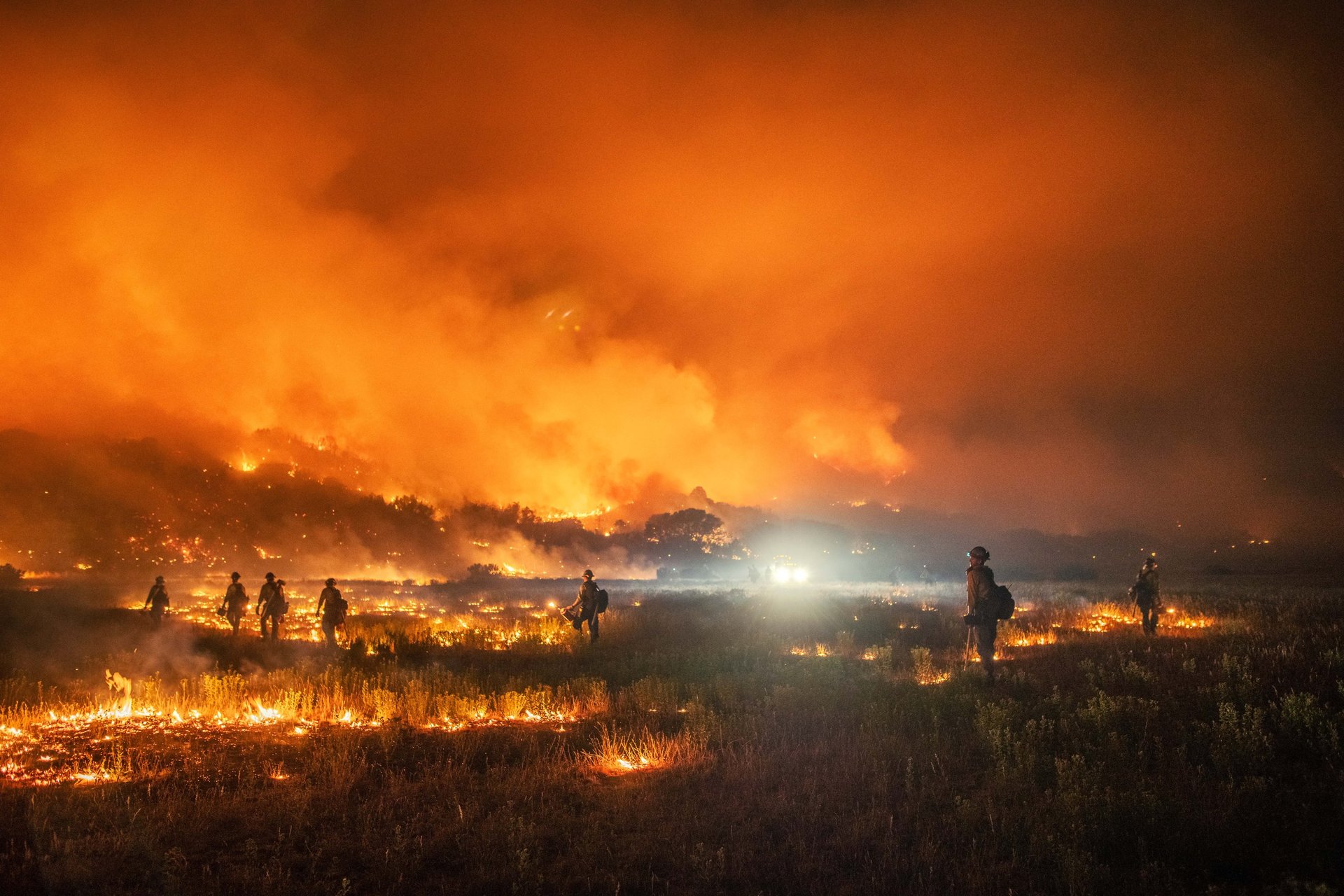
Pine Gulch Fire 2020: Grand Junction Field Office
The world is facing an unprecedented emergency that threatens to compromise the lives of our youngest generation, placing on them an intolerable burden – uncontrollable climate change on a path to +3°C above pre-industrial levels. Fig. 1 below shows that global temperature has already risen 1.5°C. If we do not decrease our carbon emissions immediately and substantially, then global temperature will continue on its current upward trajectory towards +3°C, a temperature at which large parts of our planet become uninhabitable.
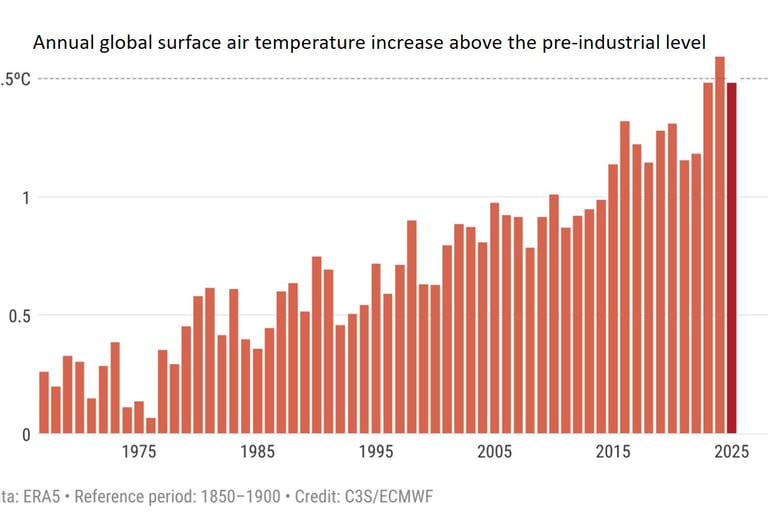
Figure 1
The Paris Accord set a target of keeping global temperature rise below 1.5°C above pre-industrial levels. The developed world, however, is welded to a lifestyle founded on fossil fuels. A rapid shift to renewable energy puts in jeopardy the fortunes of those whose wealth relies on coal, oil and gas extraction, processing and combustion. They, it seems, have a louder voice than the green lobby. As a consequence of this, the Paris Accord was and is pie in the sky.
What lies ahead, however, is far more calamitous. Fig. 2 is not some doom-mongering rhetoric. It is a simple mathematical fact that even graphically-challenged politicians can understand: a prediction of global temperature increase up to the end of this century based on the current rate of increase, i.e. assuming that nothing changes before 2050. Make no mistake. The greenhouse gases currently in our atmosphere are going to remain in our atmosphere for many years (CO2 - hundreds of years) to come. Their impact on global temperature will continue well beyond 2100. If we add more (we are) then we will not see a slowing of global warming. Figure 2 displays a future which has become more likely than not, no matter how many solar panels or wind turbines we erect.
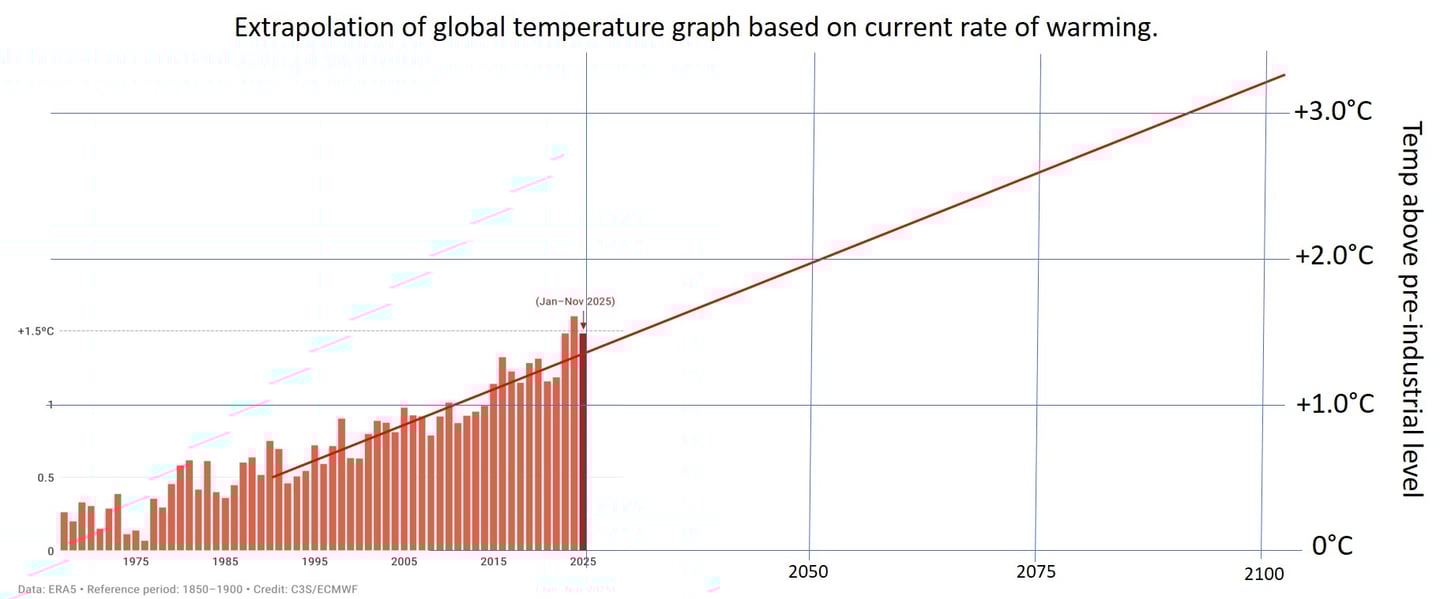
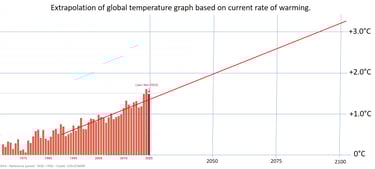
Figure 2
'Above the 2°C threshold, dangerous and cascading effects are predicted to occur, with many areas experiencing simultaneous multiple impacts due to climate change.'
For the sake of our children and every generation thereafter, we must prevent global temperatures reaching 3°C above pre-industrial levels. Whatever it takes. Whatever it costs.
This website aims to present the facts which support our current understanding of climate change in such a way that the layperson without much background in science can quickly gain an informed and balanced view of this rapidly developing global crisis. The three main sections of the website - causes, impacts and mitigation (slowing climate change) - are each subdivided into more specific units which look in more detail at what has, and is, happening in different parts of the world.
Sources of data include, amongst others:
Our World in Data
United Nations Department of Economic and Social Affairs
National Oceanic and Atmospheric Administration
National Aeronautic and Space Administration (NASA)
Central Intelligence Agency (CIA)
International Panel on Climate Change (IPCC)
Goddard Institute for Space Studies
Copernicus Climate Change Service
Energy Institute
Massachusetts Institute of Technology (MIT)
European Commission Joint Research Centre
Polar Science Centre
Natural Resources Defense Council